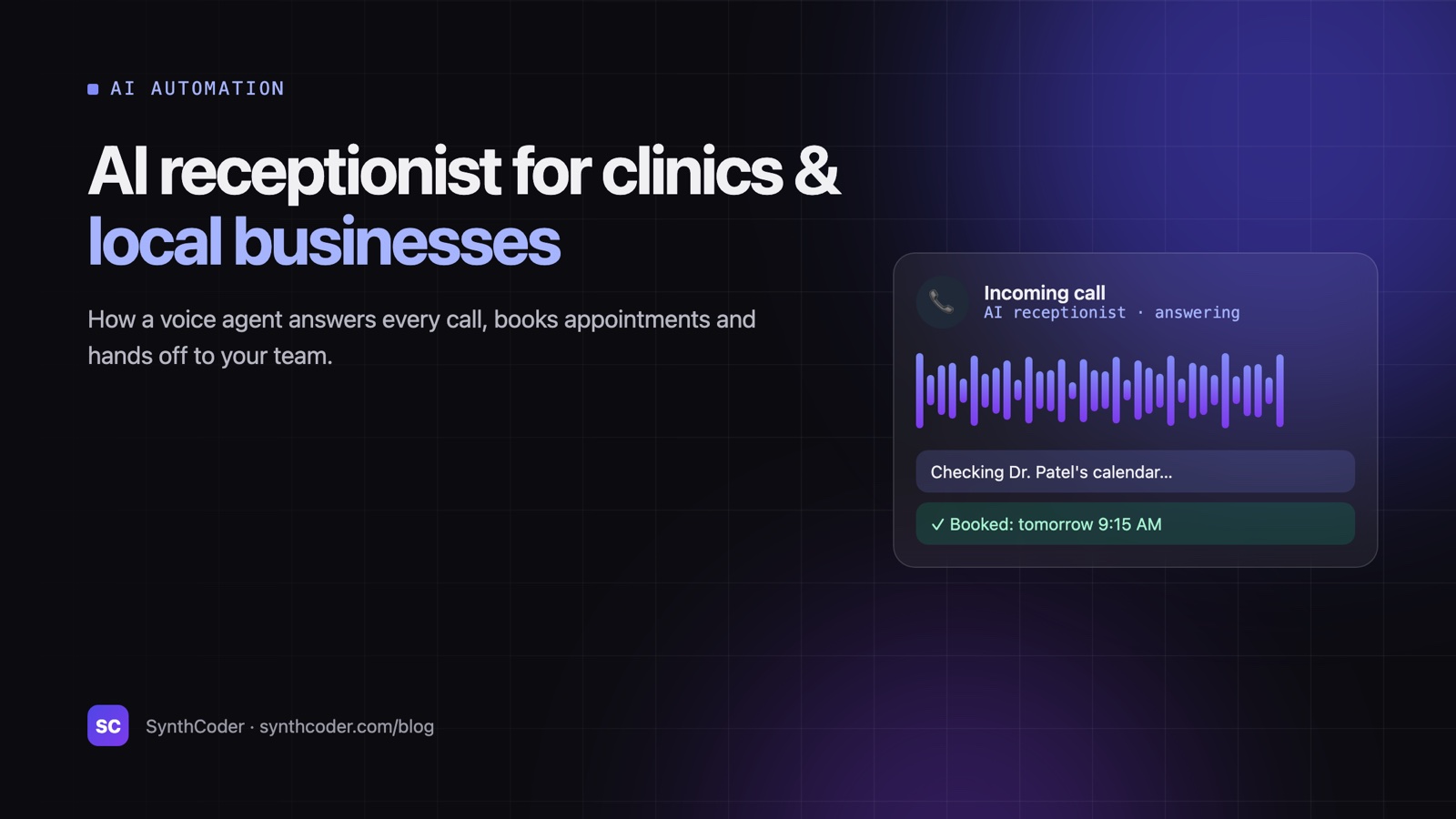
Quick answerAn AI receptionist is a voice agent that answers your business number, talks with callers in a natural voice, checks your calendar, books or reschedules appointments, and hands the call to a person when it should. A typical build connects a Twilio phone number to an ElevenLabs voice agent, your booking system and your CRM. It works best for high-volume, repetitive calls: bookings, opening hours, prices, directions and simple triage.
Missed calls are missed bookings. A clinic, salon or repair business that sends calls to voicemail at lunch, after hours or during a rush loses customers to whoever picks up next. An AI receptionist picks up every call, any time, and handles the routine ones completely.
What an AI receptionist does
A well-built AI receptionist is not a phone menu (“press 1 for…”). The caller simply talks, and the agent:
- Answers questions about services, prices, opening hours, location and preparation instructions, from a knowledge base you control.
- Books, moves and cancels appointments by checking real availability in your calendar or practice software while the caller is on the line.
- Takes messages and captures the details your team needs (name, number, reason for calling) in a consistent format.
- Triages urgent calls and transfers them to a person, with a short summary so nobody has to ask the caller to repeat themselves.
- Follows up with an SMS confirmation and logs a transcript and summary in your CRM or inbox.
How a call works, step by step
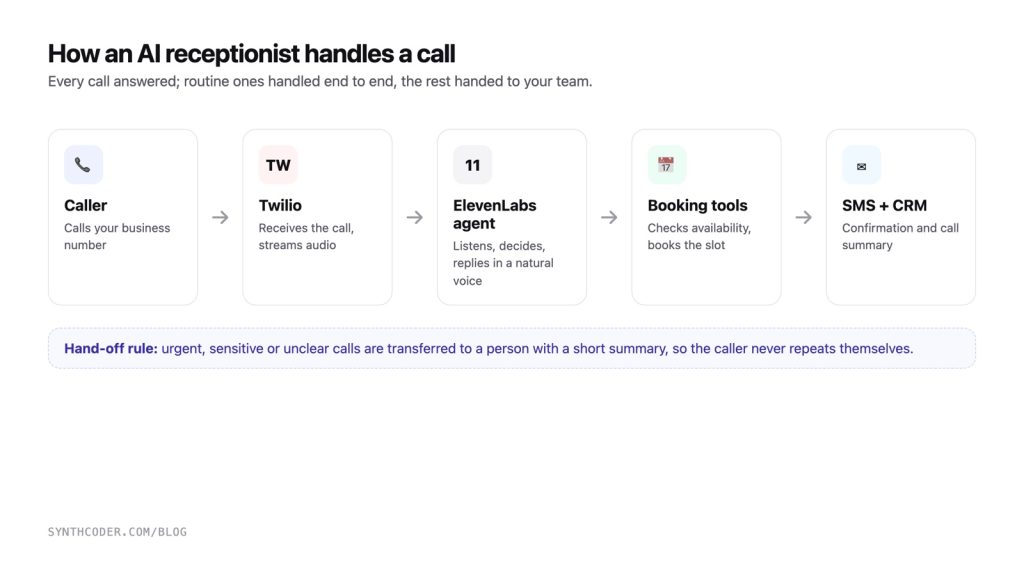
- The call arrives. Your business number (new, or forwarded from your existing line) is a Twilio number. Twilio receives the call and connects the audio to the voice agent.
- The agent listens and speaks. ElevenLabs converts the caller’s speech to text, a language model decides what to say, and a natural-sounding voice replies, usually fast enough to feel like a normal conversation.
- The agent uses tools. When the caller wants a slot, the agent calls your booking system through a webhook (“check availability”, “book appointment”) and reads back the real options.
- It confirms. The booking is written to your calendar and the caller gets an SMS confirmation.
- It hands off when needed. Emergencies, complaints or anything outside its rules are transferred to a person, or turned into an urgent message if nobody is available.
- Everything is logged. A transcript and a structured summary (intent, outcome, follow-up needed) land in your CRM or email after every call.
What it handles well, and what needs a person
| Let the AI handle | Route to a person |
|---|---|
| New bookings, reschedules and cancellations | Medical emergencies and anything clinically urgent |
| Opening hours, location, parking, prices | Complaints, refunds and billing disputes |
| “Do you offer…?” and preparation questions | Callers who ask for a human |
| Taking structured messages after hours | Situations not covered by your written rules |
| Confirmation and reminder calls | Sensitive conversations (diagnoses, results) |
The rule of thumb: if a well-trained new receptionist could handle it from a script on day one, the AI can too. If it needs judgment, empathy or authority, it should go to a person, and the agent should be built to recognise that quickly.
The building blocks
Phone number and call handling: Twilio
Twilio provides the phone number, receives inbound calls, places outbound calls, transfers calls to staff and sends SMS. You can keep your existing number and forward it, or port it.
The voice agent: ElevenLabs
ElevenLabs Agents handle speech recognition, the conversation logic (a language model with your instructions and knowledge base), turn-taking and the voice itself. Agents can call external tools through webhooks, which is how they check calendars and book appointments, and they support many languages, useful for clinics serving mixed-language communities.
Your booking system
The agent needs an API to read availability and create bookings: Google Calendar, Calendly, or your clinic or salon software if it has one. This is usually the part that takes the most care, because booking rules (appointment lengths, buffers, which staff do which services) must be encoded exactly.
CRM and notifications
Summaries and transcripts go to your CRM, a shared inbox or WhatsApp, so the team sees what happened without listening to recordings.
What it costs to run
Running costs are usage-based, so budget per minute, not per seat:
- Phone number: a small monthly fee per number.
- Telephony: a per-minute charge for inbound and outbound calls, plus per-message SMS fees.
- Voice agent: a per-minute charge for the conversation (speech, language model and voice), depending on your plan.
- Build and maintenance: a one-time setup (scripts, knowledge base, integrations, testing) and small ongoing changes as your services change.
A simple way to estimate: (expected call minutes per month) × (telephony rate + agent rate) + number fee. Check current pricing on Twilio’s and ElevenLabs’ pricing pages, since both change. Most local businesses find it costs a fraction of a full-time salary, while answering 24/7.
Disclosure, recording and patient data
- Say it’s an AI. Open with something like “Hi, you’ve reached Maple Dental, I’m the clinic’s virtual assistant.” Callers accept AI far more readily when it’s honest, and some places require disclosure.
- Recording and consent. Call-recording rules differ by country and, in the US, by state (some require every party’s consent). Tell callers if calls are recorded and keep only what you need.
- Health information. If you are a US healthcare provider handling protected health information, use vendors that will sign a Business Associate Agreement and keep the agent’s access to the minimum needed. Elsewhere, follow your local data-protection law.
- Payments. Don’t take card numbers by voice. Send a secure payment link by SMS instead.
A launch checklist
- Write down your top 20 call reasons and the correct answer or action for each.
- Define booking rules: services, durations, buffers, who can do what, how far ahead.
- Define handoff rules: what counts as urgent, who gets transferred, what happens after hours.
- Connect the calendar and CRM; test every tool with fake bookings.
- Run 30–50 test calls with real staff playing difficult callers (accents, background noise, changing their mind).
- Launch after hours first, review transcripts weekly, then extend to busy daytime hours.
- Track answer rate, bookings made, transfers and “didn’t understand” moments, and fix the top issue each week.
We built a working AI voice receptionist demo on exactly this stack, and an outbound version that calls new web leads back within minutes. If you want one for your business, see our AI automation service.
Frequently asked questions
Will callers know they are talking to an AI?
They should. Modern voices sound natural, but the agent should introduce itself as a virtual assistant. Honest disclosure builds trust and avoids complaints, and in some places it is required.
Can an AI receptionist speak more than one language?
Yes. ElevenLabs voice agents support many languages and can switch to the caller’s language, which helps clinics and businesses serving multilingual communities.
What happens when the AI doesn’t know the answer?
It should never guess. A well-built agent takes a message or transfers the call to a person, and logs the question so you can add the answer to its knowledge base.
Can it take payments over the phone?
It shouldn’t collect card numbers by voice. The safer pattern is to send a secure payment link by SMS during or after the call.
Does an AI receptionist replace front-desk staff?
Usually not. It takes the repetitive calls and the after-hours calls so your staff can focus on the people in front of them and on the calls that need judgment.
How long does it take to set up?
A focused build (one phone number, a booking integration, handoff rules and testing) typically takes a few weeks, most of it spent getting booking rules and test calls right.